
Speech: A Road Ahead for the UK-EU Partnership
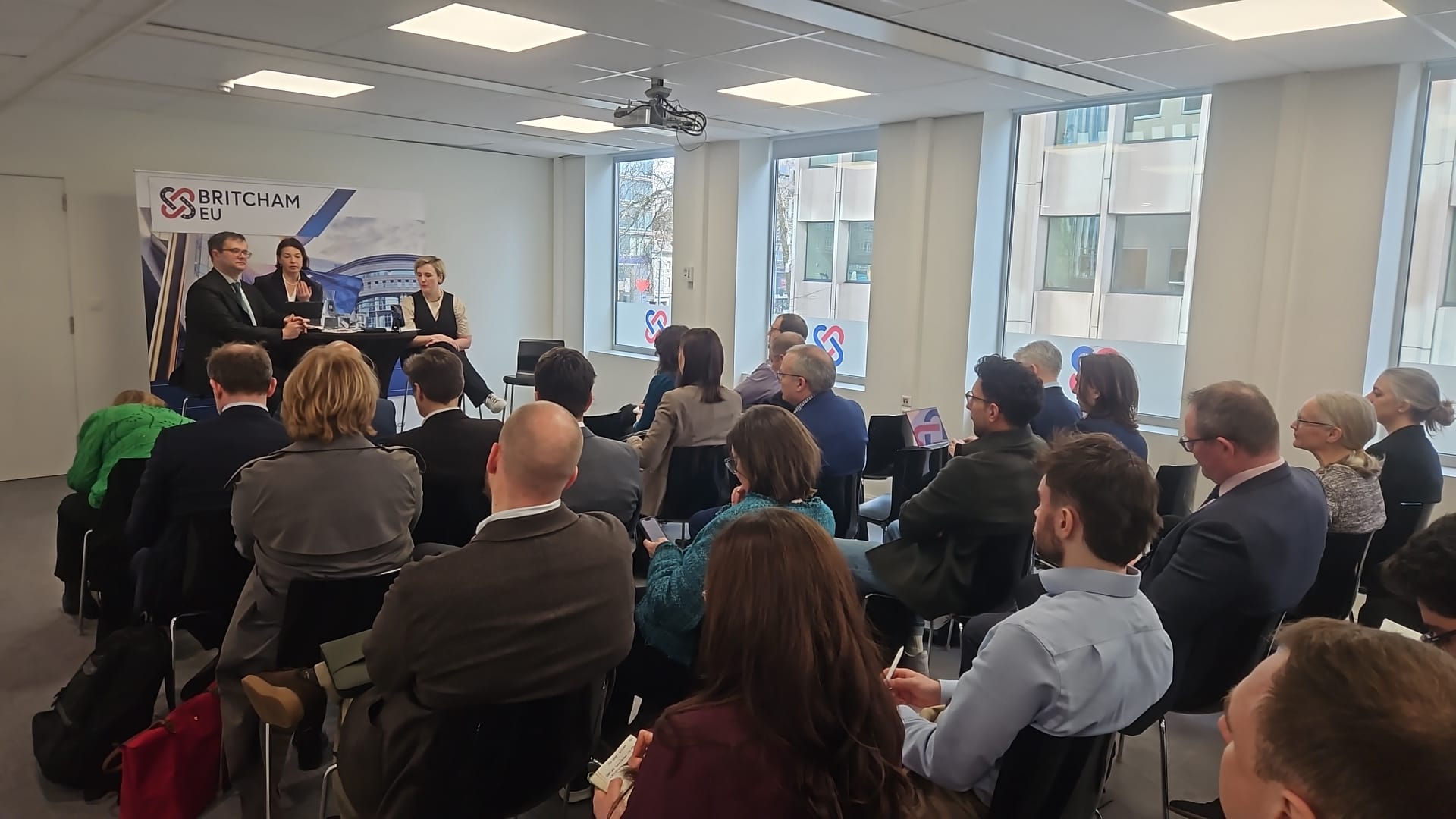
British Chamber of Commerce in the EU, Brussels
Tuesday 17 March 2026
Stella Creasy MP
Thank you to the British Chamber of Commerce for hosting me today.
Today I want to talk about reunions. The subject of a million songs, films, books, and conversations over wine. All whilst our friends look on in horror.
Given how important we all know the relationship between Europe and the UK is, we need to find a way to make sure we are not Ben Affleck and Jennifer Lopez.
Rom-coms tell us that the right gesture, at the right moment, can change everything. So what does the EU need from us today?
For the avoidance of doubt, I’m not proposing Keir Starmer stand outside Ursula von der Leyen’s window with a boombox playing Peter Gabriel. Still less to turn up, Jerry Maguire style, outside the Commission, shouting “You complete me.”
No, today I want to look at a real reunion in the UK that actually happened last year to great acclaim and measurable impact on GDP – and yet nearly didn’t. I’m talking of course about the Oasis reunion of 2025.
And this reunion has more lessons for the UK-EU relationship than you might think.
There are two refrains I hear repeatedly in Brussels, and both of them Noel and Liam Gallagher know well.
Just as Liam took decades to process the pain caused by Noel breaking up the band, I often hear in the EU that Brexit felt like the UK trying to undermine the core notion of European solidarity.
It didn't just feel like Britain leaving. That was bad. Then the manner of leaving – the hardest of hard Brexits – felt like an attempt to destabilise the Union all together. Until that is acknowledged, really acknowledged, the emotional barrier to any serious rapprochement remains.
For the Oasis obsessives here, you cannot skip straight to Wembley in 2025 without dealing with what happened at the Paris show in 2009.
The other lesson comes from Noel. What he needed from Liam, above all, was consistency. He could be difficult if he wanted. But Noel needed him to show up night after night.
Consistency is what Europe says it needs from Britain. Many would welcome a constructive voice back at the table. Many are understandably terrified the next election delivers Prime Minister Farage instead – or a Parliament filled with a chaotic mix of Reform, Greens and a ragtag of independents – and the UK goes from potential partner to red-flag central.
Keir Starmer and his team should be commended for the work they have done to rebuild relationships, after our nation sent a Prime Minister who couldn’t decide if European leaders were friends or foe. Or, it seemed, last longer than a lettuce.
But consistency is still a work in progress. Take this week alone. The Chancellor in just a couple of hours will give a lecture we are told will make the case for getting closer to the single market. Yet yesterday, we saw the EU Minister reinforce the fabled red lines: no single market, no customs union, no free movement.
This matters because there’s every reason to believe both the UK and the EU each now want to get the band back together.
But confused messaging would be a poor basis for negotiation at the best of times. In the world we’re dealing with today it is a fatal error.
Since 2016, the world has changed in ways which make Brexit even more damaging for both the EU and the UK than it seemed even at the time.
There is a major land war raging on the EU’s borders.
The US President doesn’t believe in NATO or free trade, doesn’t even pretend to believe in international law, and is definitely no fan of the EU.
China is embedded in our common supply chains while apparently spying on our Parliaments and preparing to take Taiwan.
As this new world emerged, we spent a decade first negotiating a bitter divorce, then cutting off our trade and security links – then realised too late that these are problems we can only solve together.
It’s easy to forget that this was a choice not an accident. Our Conservative Brexiteer governments were determined to leave not just the single market and the customs union, but practically everything with ‘European’ in the name, from foreign policy cooperation to biosecurity warning systems.
Both sides are paying the price. EU trade in goods with the rest of the world has grown by 51% since 2016. With the UK it has grown only 1.7%.
But the big impact has been felt by Brits. Somewhere between four and eight percent in GDP. 16,400 British small businesses gave up trying to export to the EU entirely, buried by red tape. And families have paid £7 billion more in food costs.
It is a relief to see a Labour government put some of this right: a security and defence partnership, yearly summits, and concrete negotiations on agrifood, energy and mobility. And on St Patrick’s day I should remember to mention that our Irish partners and the EU have a government implementing the Windsor Framework in good faith, after years of stress.
Outside the formal EU-UK structures, we’re seeing real world cooperation on Ukraine. When things are really serious, there is no doubt we are the closest of allies.
But that makes it all the more baffling to see how timid and confused the UK’s offer to the EU has been.
Those red lines have pinned us down into arguing to our voters that Erasmus+ is the be all and end all.
We have oversold the effects of agrifood and energy agreements that will be good if and when they arrive, but ultimately are a drop in the ocean of Brexit’s harms – just 0.3% added to GDP by 2040.
The red lines have trapped us into failing to put jobs and supply chains first.
We shouldn’t underestimate how fragile even this partial reset is, and how much can still go wrong.
Take the failed negotiations on the UK joining the SAFE defence fund. Right now there couldn’t be a more urgent need to cooperate on defence industries. Yet we fell into the old bitter Brexit dynamics.
The EU’s asking price for SAFE was far too high and the UK was right to walk away. But the reason we ended up there is that nothing in the reset so far promises a fundamentally new start. It’s like Henry Kissinger’s joke about academic politics – the reason it’s so vicious is that the stakes are so low.
We’re bickering over student fees and pesticides while our economies stagnate and our common security erodes.
Watching this from Brussels, I understand why many – even those who say they want us back – want to see we can push the tough stuff through first.
So while it’s encouraging to hear the Chancellor say we want to go further, I don’t think we fully appreciate how this sounds to a partner that’s been hurt before.
The UK can’t start every conversation with what we want, instead of what Europe might need or care about.
The truth is that the UK on its own is not at the top of the EU’s list of priorities.
The EU is being squeezed by American tariffs and Chinese exports.
European leaders are convinced that the single market needs reform, but divided on how to make that happen.
What spells trouble for the UK is that some EU answers to these problems have been to raise the costs of being out of the club – not just on SAFE, but in “Made in Europe” rules which could hammer our car industry, and thumping new tariffs on steel.
So we must take this moment seriously. How can we be more than a sidebar issue and offer more than a wishlist?
Some people in Parliament and in my own party think the answer is a customs union. But this doesn’t hold up to scrutiny. A customs union gets rid of rules of origin requirements for exporters. This would be good, but it is still not a game-changer – worth something like 0.5% of GDP to the UK according to academic estimates.
Any benefits beyond that are not really about a customs union, but about dropping the paperwork, labelling and inspections that come from separate systems of regulation.
Fixing those problems is about negotiating participation in the single market, not a customs union.
To burst many bubbles, the answer for now is also not rejoin. We can’t expect the EU to take that leap of faith on a divided UK, nor should Brits think that rejoin negotiations would be simple or quick – and in the meantime, this would call a stop to the salvage operation our businesses desperately need.
Instead we need to come back to the fundamental trade-offs of Brexit, and find the trade-off that delivers the biggest benefit. The basic truth remains that a non-member’s participation in the single market comes with a price – both a financial price tag, and at least some degree of free movement of people.
The Swiss model, as the Swiss themselves will tell you, is not something the UK could simply copy and paste. And until last year, it was not one that the EU liked all that much – having been built up over decades in a patchwork of agreements. It is complex, and it is work.
But last year’s agreements have put the relationship on a firmer footing, based on a balance of rights and obligations. Balance, not special pleading – that’s the key principle that the UK should offer, and which the EU could realistically accept.
A Swiss-style solution could put the UK into the single market for industrial goods, energy, agrifood and transport, with mutual recognition of conformity assessments. It would be mostly out of the single market for services, but with mutual recognition of qualifications. And the UK could be a member of EU programmes, some of which it has already rejoined, including Horizon and Erasmus+. The Northern Ireland issue would be largely resolved.
In return the UK would make financial contributions and sign up to some form of dynamic alignment with EU law, including a role for the European Court of Justice. Compromises which either have already been made in principle, or are likely to be made if the UK goes for alignment in any sectors beyond those agreed last May.
Switzerland, of course, accepts free movement of people with controls. This touches the toughest political topic in the UK at the moment. But a brave government shouldn’t fear this fight.
What we call “free” movement in Switzerland means you need to register with the local authorities and show you are employed. If you are not employed, you need to show sufficient funds not to need state benefits, and you need to have health insurance. And Switzerland has an emergency brake, meaning that if migration is causing “serious economic or social problems”, free movement can be suspended and the case will then be taken to arbitration.
And let’s be honest about where we are. The UK is an open trading nation with an ageing population. A government that can’t make the case for labour mobility with its closest neighbours and biggest trading partner is a government without a model for economic growth.
The point here is not that we can jump to a Swiss solution tomorrow. Manifestos matter. This is a vision that Labour would need to take to the public for a clear mandate in the next general election. It also might require a new Commission mandate. But it is one that accepts the constraints we have, and puts the UK firmly in the European camp.
We are ten years into this mess. Five into the hardest of hard Brexits. Half the world away from where we need to be. Which takes us back to Oasis.
I started this speech with the reminder that, if Liam and Noel could make it up and get back together, then so can we. Yet I go back to the key difference between the UK and the EU and the Gallagher brothers.
For a decade, our partners in Europe have been hearing the Brexiteers’ version of Wonderwall. They would be happy never to hear it again. What they want is something new, not the same old tunes from the failed era of Tory government.
A vision for a Swiss-style partnership, based on a balance of rights and obligations. Close collaboration on defence, security and supply chains.
That is a Britain that turns up to the venue on time, knows its own setlist, and doesn't pick a fight with the support act on the way in.
Friends, let’s make it happen. See you at the reunion.
Share